
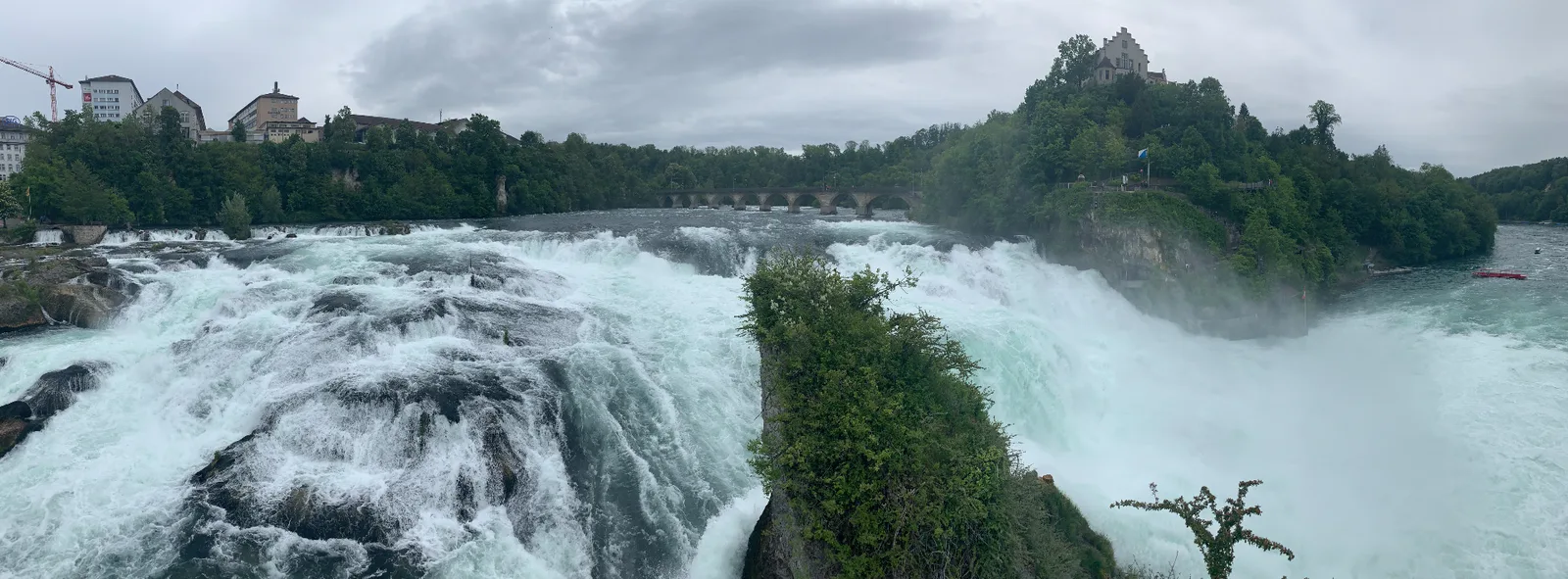
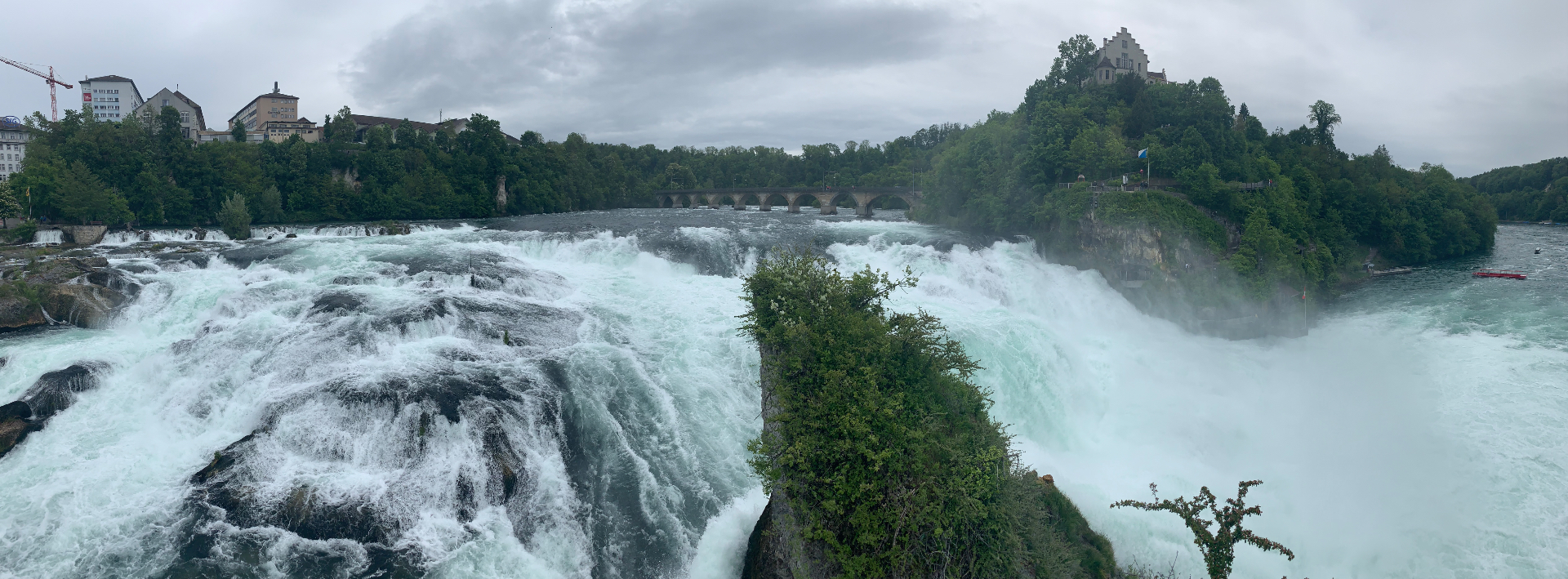
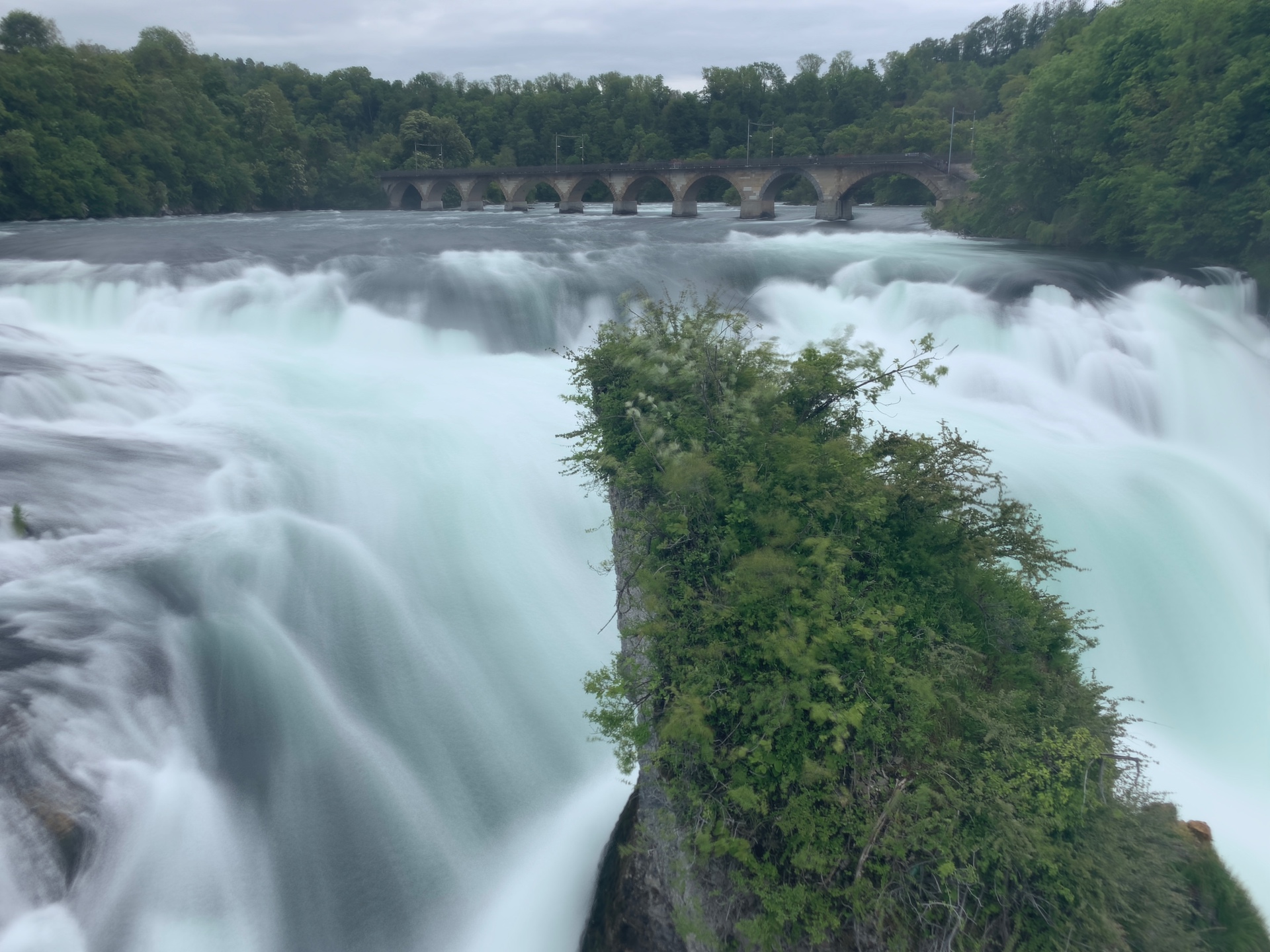
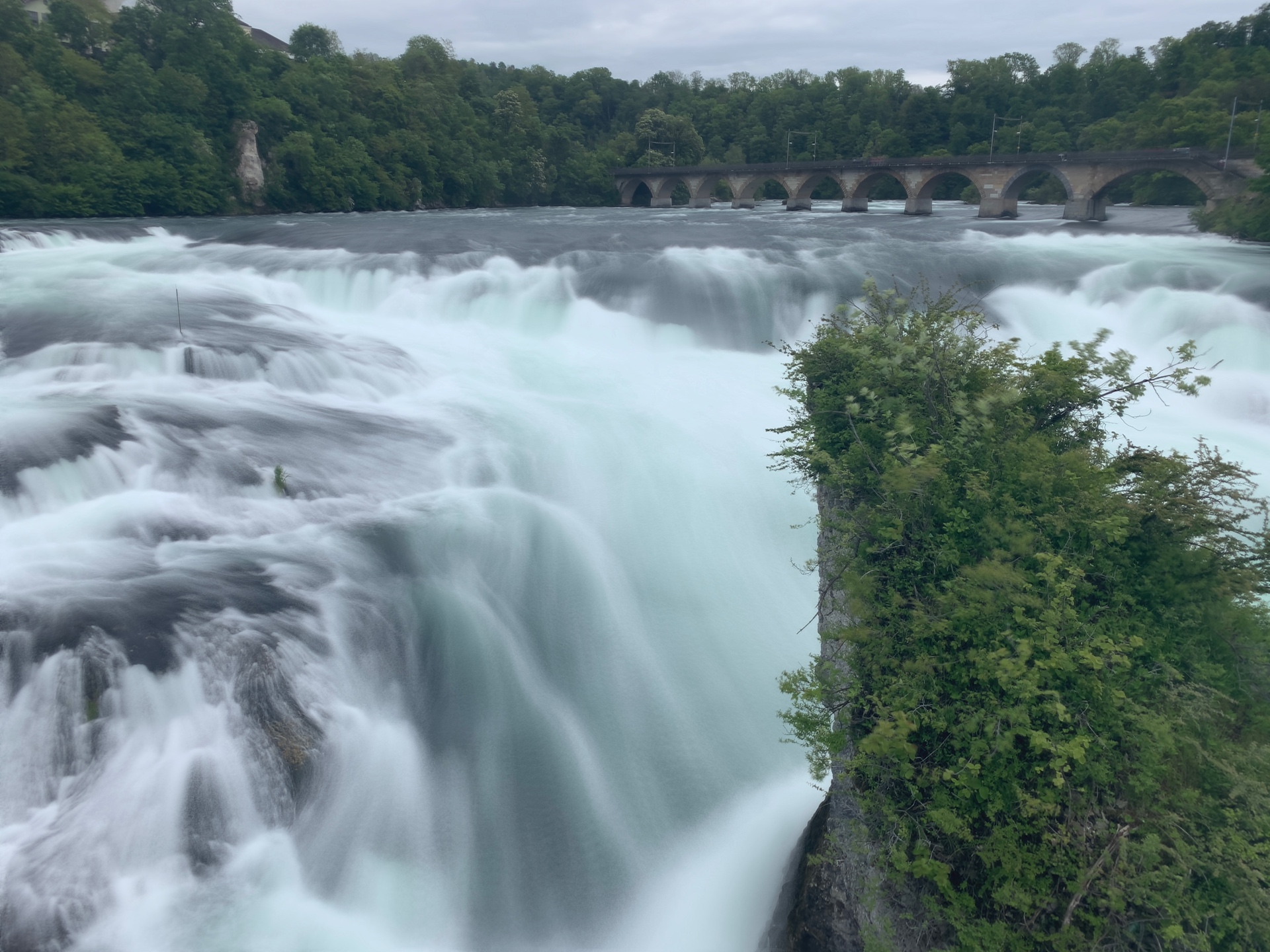
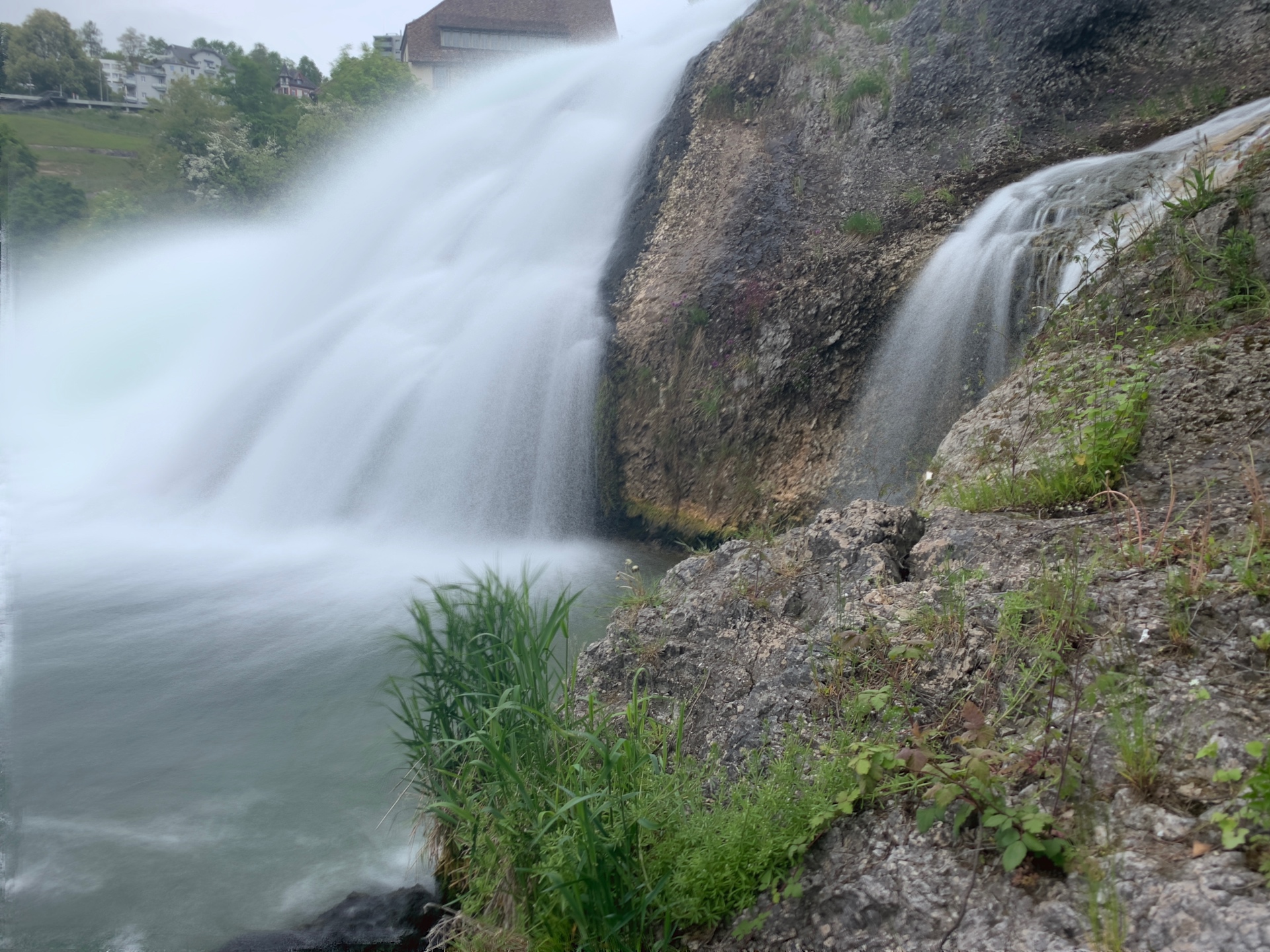
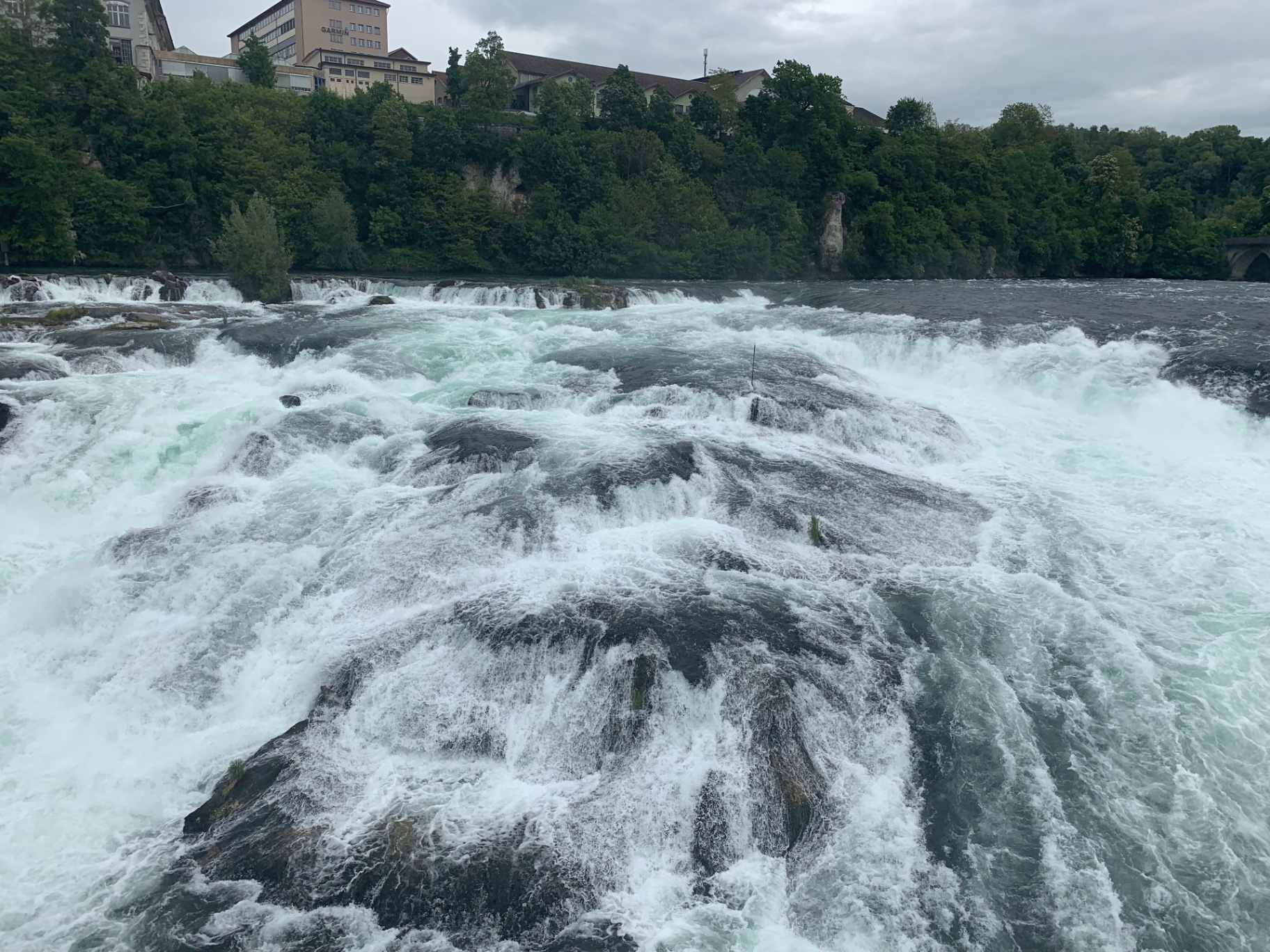
The Rhine Falls don’t so much fall as detonate. Six hundred cubic metres of the Rhine a second go over the lip and land as a single, ground-shaking roar, and by the time you’ve walked down to the water the spray has already found the inside of your collar. I went on a grey morning in late May — the river swollen with snowmelt, the falls at their loudest — and stood on the little iron platform at the base while the whole thing tried to soak me.
I’d come for a quieter reason than the spectacle, though. In June 1887, a young Filipino doctor stood roughly where I was standing — and he is the reason this waterfall belongs on a Philippine travel blog at all.
A staircase into the roar
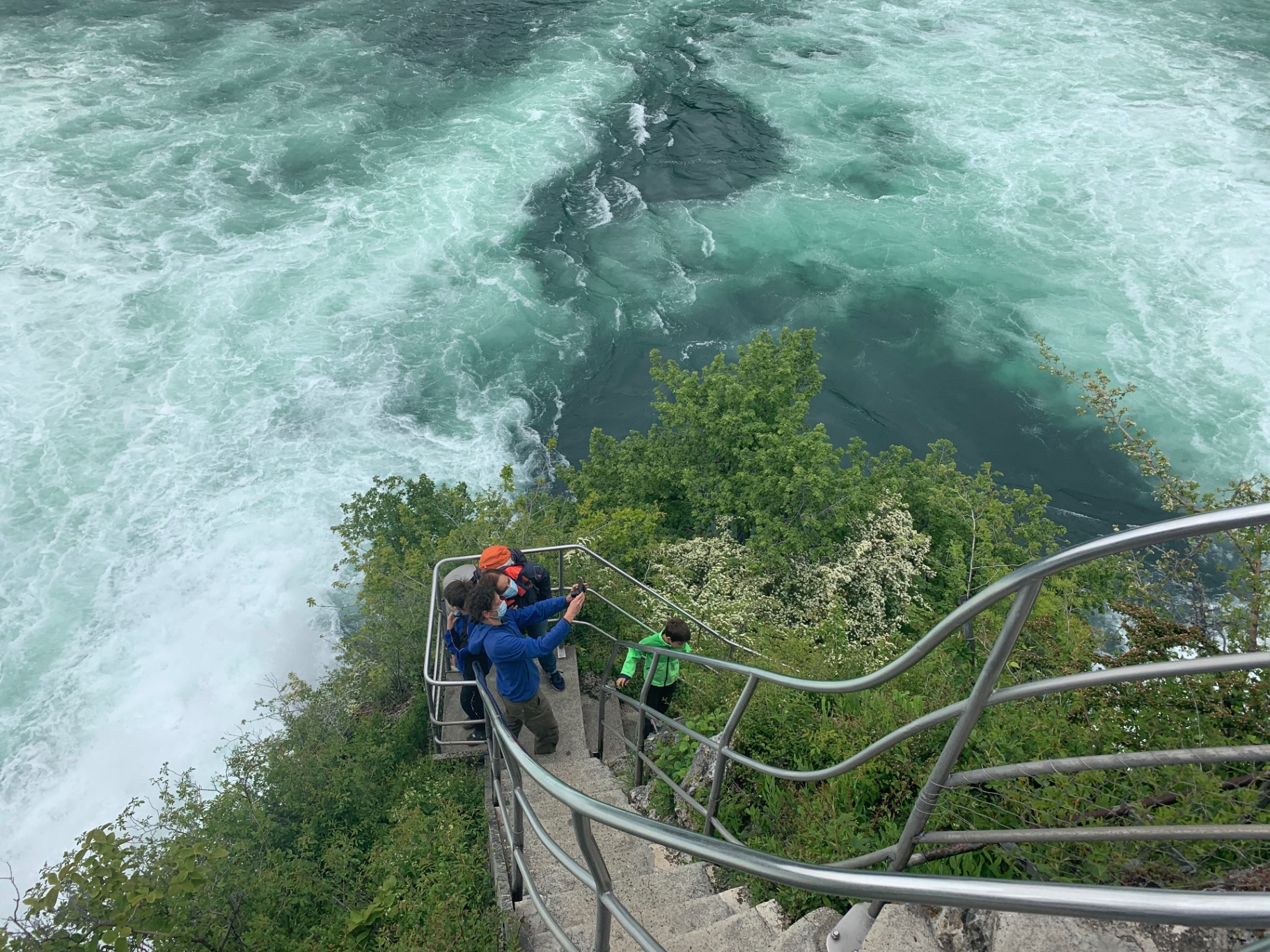
The best way to meet the falls is from below. From Schloss Laufen, a set of switchbacking metal stairs drops down the cliff face toward a viewing deck that sits almost level with the water. Every landing gives you a different version of the same violence: first the wide sweep, then the green-black rock the river folds around, then — at the bottom — nothing but white noise and mist. Upstream the water is almost calm; then the riverbed simply ends. Watching it go over is oddly hypnotic, and worth the climb back up afterward.
June 1887: Rizal at the Rheinfall
José Rizal arrived in Schaffhausen by train on 2 June 1887 with his friend and travelling companion Máximo Viola, and the two checked into the Hotel Müller on Bahnhofstrasse. They had come the long way round — down through Germany from Berlin, by riverboat along the Danube, past Munich and Ulm — on a grand tour of Europe taken as a kind of reward. Rizal had just published Noli Me Tángere in Berlin that March; Viola had helped pay for the printing, and once Rizal repaid him they spent the summer seeing the continent before he sailed home.
The Rhine Falls were an obvious stop. Viola later remembered them simply as the most beautiful waterfall in Europe. The castle on the rock — Schloss Laufen — and the long stone bridge were both already there in 1887, which is the quiet thrill of the place: strip out the modern buildings on the far bank and the view is more or less the one Rizal had.
The story he already carried
It’s tempting to say Switzerland inspired Rizal — but by the time he reached the Rheinfall, the Swiss story that mattered to him was already his. A year earlier, in 1886, he had translated Friedrich Schiller’s Wilhelm Tell — the Swiss national drama about a people throwing off a tyrant — from German into Tagalog, so that Filipinos could read it in their own language. So when he stopped at this waterfall in the country of William Tell, he wasn’t gathering material. He was walking through the landscape of a liberty story he had already made his own.
He’d go on from here to Geneva, where he spent his 26th birthday. I wrote about that stretch — and the Tell translation — in José Rizal in Geneva. For the earlier leg, see A las Flores de Heidelberg.
Planning your visit
- Getting there: The Rhine Falls sit between Neuhausen and the town of Schaffhausen, about an hour from Zürich by train — there’s a station right at Schloss Laufen (check current SBB times before you go).
- Which side: Schloss Laufen, on the Zürich-side bank, has the viewing platforms and the staircases down to the water. Boat trips run out to the rock in the middle when the river isn’t too high.
- When: Late spring and early summer — snowmelt season, the same time of year Rizal came — give you the falls at full force, and the most spray, so bring a jacket.
- The Rizal connection on the ground: In Schaffhausen town, a plaque on the former Hotel Müller (Bahnhofstrasse 28) marks where Rizal and Viola stayed on 2–3 June 1887.
Walking back up the stairs, soaked and half-deafened, I thought about how ordinary the stop must have felt to him — a good waterfall on a summer holiday, before the long boat home. He had nine years left, and most of what he is remembered for was still ahead. But standing at the same railing, it’s the smallness of the moment that stays with you: not the hero, just a young man on a trip, pausing to watch the river fall.